Conflict as Connection: Tools for Better Communication
By Kendall Johnson, NOMV Volunteer Coordinator
Conflict is an inevitable part of any group of passionate, committed people. When technicians, vets, and support staff care deeply about patients and clients, differing opinions about treatment priorities, workload, or communication with pet owners are bound to surface. Rather than a sign of dysfunction, conflict can be a powerful catalyst for connection, an opportunity to deepen understanding, clarify shared goals, and strengthen collaboration. At its core, conflict simply means that two or more people see something differently. Some conflicts are task-related and center on ideas, strategies, or decisions that affect the work itself. Others are relational, stemming from emotions, communication styles, or perceived intentions. Recognizing these distinctions helps teams address disagreement with empathy and curiosity, transforming tension into trust and productive dialogue.

Conflict emerges from the everyday realities of working with other people. It often begins with miscommunication, or an assumption that goes unspoken. It can stem from differing values or priorities, when what feels urgent to one person feels optional to another, or from assumptions and misunderstandings that quietly grow into frustration. For example, a veterinarian assumes a technician knows to draw pre-op bloodwork before surgery, while the tech believes it was already done by another staff member. When the oversight is caught mid-procedure, tension flares, not from incompetence, but from unclear expectations. Power dynamics can deepen tension, leaving people unsure whose voice matters or how decisions are made. In high-stress environments like veterinary care, external pressures like fatigue, emotional load, or limited resources can make even small disagreements feel heavy. How we respond to these moments shapes whether conflict divides or connects us. Some people compete, striving to win; others collaborate, searching for shared solutions. Some compromise to find balance, avoid to protect peace, or accommodate to preserve relationships. Each approach has its place, but real growth happens when teams notice their patterns and choose responses that foster respect, learning, and connection.
Conflict Resolution Tools
L.E.A.P.S. Model
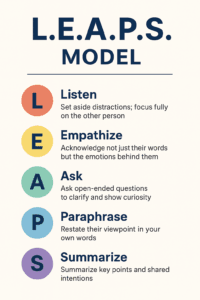 When conflict arises, one of the most effective ways to turn tension into understanding is through the L.E.A.P.S. model, a simple, intentional approach to communication that centers connection. It starts with Listen: set aside distractions, quiet your inner rebuttal, and focus fully on what the other person is saying. Then Empathize, acknowledging not just their words but the emotions behind them. “I can see this has been really frustrating” can go a long way. Next, Ask open-ended questions to clarify meaning and show curiosity rather than judgment. Paraphrase what you’ve heard in your own words to check understanding and demonstrate that you’re truly engaged. Finally, summarize the key points and shared intentions, creating a foundation for moving forward together.
Ex. A client service representative feels overwhelmed handling back-to-back calls and frustrated when technicians don’t answer the phone.
- Listen: The tech gives the CSR space to vent about the pressure.
- Empathize: “I get that, it’s hard when the phones are nonstop, and you’re trying to help everyone.”
- Ask: “What times of day feel most intense for you?”
- Paraphrase: “You’re saying the 4–6 p.m. rush is the toughest because we’re tied up in rooms.”
- Summarize: “Let’s plan for one tech to rotate phone duty during that time so calls don’t pile up.”
Feelings, Facts, Future
 Building on the principles of L.E.A.P.S., the “Feelings, Facts, Future” tool offers another way to navigate challenging conversations with clarity and compassion. It starts by addressing Feelings: acknowledging the emotions in the room, your own and others’, without judgment. Naming what people feel (“I can hear that you’re frustrated,” or “I felt anxious when that happened”) validates experience and helps diffuse tension. Then shift to the Facts: what actually occurred, separate from assumptions, stories, or blame. Grounding the discussion in observable details brings shared understanding. Finally, turn toward the Future, focusing on what can change or improve moving forward. What agreements, actions, or supports will help the team stay aligned? By moving through these three steps, conversations that might otherwise spiral into defensiveness become opportunities for learning and connection.
Ex. In a disagreement over a surgical complication, a technician might start with, ‘I felt anxious when we
discussed the outcome in front of the client’ (Feelings), followed by, ‘What actually happened was the client arrived early and overheard part of our case review’ (Facts), and finally, ‘In the future, can we plan private debriefs before client conversations?’ (Future).
Stop, Step Back, Step In
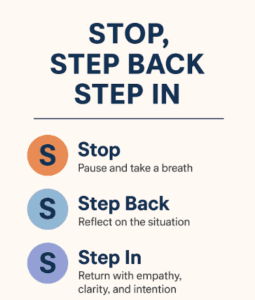 In moments of tension, it’s easy to get swept up in emotion or urgency. The “Stop, Step Back, Step In” tool offers a simple way to slow down and re-center before reacting. First, Stop: pause long enough to take a breath and notice your immediate thoughts or feelings. This moment of stillness prevents impulsive reactions that can escalate conflict. Next, Step Back to reflect: What’s really happening here? What might the other person be experiencing, and what’s driving your own response? This perspective-taking creates space for understanding. Finally, Step In: return to the conversation with empathy, clarity, and intention. By following these three steps, we move from reacting to responding, turning conflict into a mindful act of connection rather than confrontation.
Ex. When emotions run high during a busy emergency shift, pausing for even ten seconds to breathe and re-center before responding can prevent reactive comments that damage trust.
Tips for Working with People Who Disagree with You
Do:
- Ask questions instead of making assumptions
- Validate feelings even if you don’t agree with them
- Use “I” statements rather than “You” accusations
- Be mindful of tone and timing
- Know when to take a break
Don’t:
- Avoid the person forever
- Try to “win” the argument
- Assume bad intent
- Gossip/triangulate information
Ex. If a coworker prefers a different anesthetic protocol, ask what outcomes they’ve seen rather than assuming they’re dismissing your approach.
Ex. When a client pushes back on cost estimates, validate their concern (‘I understand this is a big expense’) before explaining options.
Conclusion
Conflict is not a problem to be avoided, it is a signal that people care and that ideas and perspectives matter. Disagreement is inevitable in any team, but it becomes an opportunity when we approach it with curiosity, empathy, and clear intention. In veterinary medicine, where compassion, precision, and emotional labor intersect daily, healthy conflict isn’t just about smoother teamwork, it’s about sustaining the trust that makes excellent patient care possible. Conflict resolution tools help us pause, listen, reflect, and respond thoughtfully rather than react impulsively. Pairing these frameworks with practical habits like asking questions, validating feelings, using “I” statements, and being mindful of tone builds trust and prevents misunderstandings. At the same time, avoiding conflict, assuming bad intent, or trying to “win” erodes relationships and collaboration. When handled well, conflict transforms tension into connection, turning differences into opportunities to learn, grow, and move forward together. Healthy conflict doesn’t just solve problems, it strengthens the bonds that make shared work meaningful and resilient.
Sources
“7 Conflict Resolution Strategies Backed by Neuroscience.” Emotions Therapy Calgary, https://www.emotionstherapycalgary.ca/blog-therapy-calgary-emotions-clinic/conflict-resolution-strategies.
“What Is the LEAPS Communication Model?” IKON Training, 10 Jan. 2024, https://ikontraining.co.uk/what-is-the-leaps-communication-model/.
Recent Posts
About Us
NOMV addresses well-being in the veterinary medical community through evidence driven programming that raises awareness on mental health in the community while providing innovative prevention and intervention programming.